I Remember, I Remember


Maysaan province, Iraq 2006

It’s always the popular ones who get done, of course. But Rich actually was – a superb all-round soldier, a Captain in the Parachute Regiment who had been on attachment to the Highlanders and so was well known to two of the three regiments who were present in Maysaan (as part of the Royal Scots Dragoon Guards Battlegroup). And he took the ‘please kidnap and hideously murder me’ job, liaison officer to the police headquarters in Amarah, and made something of it. He boxed (as most paratroopers do because of the place of milling, a non-stop, high-intensity version of boxing they use in their selection process) so we had something in common and he was just easy to get on with anyway (not always the case with the Parachute Regiment).

To foil the campaign of IEDs (Improvised Explosive Devices – what the media inaccurately refers to as ‘roadside bombs’ because they aren’t necessarily planted by the side of the road or even on the road for that matter), we would front up our convoys with tracked, heavily armoured Warriors, followed by the lightly armoured, wheeeled Snatch Land Rover. But as fast as we changed our tactics, the other side would respond and the dog-fight continued. We had put heavier armour at the front of the convoys: the devices became larger, eventually taking out Warriors and Challenger tanks alike (but that was during later tours by which time I had hung up my uniform and moved north to the ‘Dad). Or the other side would revert to something simple like a claymore mine, simply peppering the exposed top-cover troops (the ones who protrude through the roof space of vehicles) with hypersonic ball-bearings. The fundamental asymmetric nature of an insurgency means it is the more intelligent, creatively agile force that wins, rather than the largest, better trained or the best equipped.

That day the other side went back to using a command-wire detonated device, allowing them to select which vehicle in the convoy to target – the second vehicle, a lightly armoured Snatch, not the heavily armoured Warrior that led the convoy.

A squat barrel of thick metal (usually iron), packed with explosives, topped with a convex disc of copper, dug into one of the numerous earth mounds or rubbish heaps that adorned the roadsides of Iraq and Afghanistan. The other side had learnt to tilt it slightly upwards, otherwise all that happened was that the wheels of the vehicle were taken out. Now, once the device was laid, the centre of the convex lid pointed straight into the cab of the vehicle.

Explosives upon detonation are like flowing water: they can be channelled. So the heavy iron casing drives the brunt of the explosive force forward through the copper lid, which melts in an instant and forms a bolt of liquid metal.

The eruption rocked the 24-ton Warrior at the front of the convoy forward on its tracks: they thought they had either gone over a mine or been hit from behind by an RPG. After the roar of the detonation, a cloud of dust shrouded the Snatch behind the Warrior.

‘I can’t describe the fookin thing goin’ aff, boss, it was the fookin loudest thing I’ve ever heard in ma life,’ said Taff.

Like the entry of a demon,’ I commented. ‘It’s from a Second World War poem by a guy called Keith Douglas. He died in late ’44 in Normandy.’

‘Yes, that was what it was like, like the entry of a fookin demon,’ said Taff.

Taff was one of my gang, was in the Snatch behind Rich’s and, once the dust cloud settled and everyone had done their own checks (universally ‘Thank f*ck’ followed by a swaggering, ‘Beat you again, Abdul’), he got out and walked forward into the haze. Only one of the two top-cover (the soldiers who stick their heads – and weapons – out the roof of the vehicle for better observation) was still up: the back doors were open and the two dismounts were in the process of falling out the back. Taff looked in the back – the other top-cover was holding his arm up and moaning because he had taken a couple of fragments under his arm. But the four in the back were okay. They would live.

And then Taff saw the front of the vehicle.

The front suspension had collapsed, the wheels splayed outwards.

‘Like the legs of a baby giraffe’, Taff commented – why he was thinking of giraffes I’ll never know, but then again he wasn’t planning on being a writer at a later point so probably didn’t feel the need to have lines of running imagery. Maybe I had started him feeling all poetic, like. Maybe poetry, which I was always so disparaging of as a teacher (‘poetry is for poofs’, as I used to tell my adoring pupils), is the only medium intense enough to capture what he saw.

The forward passenger side of the Snatch was blackened from the blast. And there was a fist-sized hole punched in the door, just below the window. Taff pulled the buckled door off.

It’s gloomy enough in the cab of a Snatch. The windows are armoured, which means the actual (toughened) glass sections are smaller. There is a thick wire mesh over the windows to protect against bricks, stones and the other gifts the locals flung us as we passed by. The whole cab is lined in a fire-retardant fabric that is akin to black canvas. Everything is caked in dust anyway.

But this time it was darker still – dark red.

A pair of legs from the knee down, a helmet with the top half of a head still in it, a buckled, pointless rifle…. A less mangled body in the foetal position in the driver’s seat. That was Ellis, Rich’s driver.
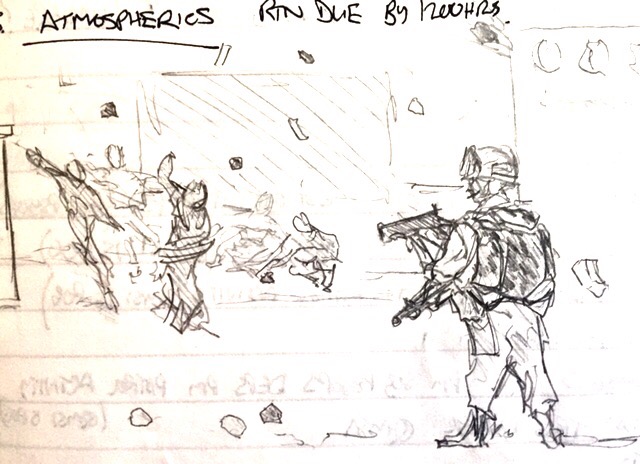

I didn’t get much more out of Taff – a mish-mash of images. Rent-a-mob appearing soon afterwards and starting to brick the reeling troops… The cheering from the crowd as the bodies were loaded onto the casevac helicopter… Taff disarming one of the dismounts from the back of Rich’s vehicle who was ‘gonna light up the fukin crowd’ with the General Purpose Machine Gun… The pop of baton rounds being fired into the crowd by the follow-up cordon troops (and the ‘thock’ as they hit)… The heavy tarpaulin being hauled over the ripped up Snatch (not the sort of thing you want sitting around camp when you are still expecting troops to go out in them)…

Things were different after that.

Shezzer changed when he got back from leave. Rich was his platoon commander. He was resilient – he had to be with the stammer he had, in the intolerant world of the Parachute Regiment . But he had pervious: he went a bit strange after his first tour of Iraq. (Shezzer got home, got sloshed and then shaved off all his body hair. Naked, he then broke into his brother’s house and hid on top of the wardrobe, only revealing himself when his brother and his Mrs were hard at it, at which point Shezzer launched himself on top of them. Luckily his brother was also in the Parachute Regiment and his Mrs’ father had been, so they understood.)

His humour went. The wit that had seen him say, in response to an Iraqi schoolgirl’s request that he marry her, ‘No weddin’, sweetheart, but you can smoke my pole if you want’ was lost for the rest of the tour. Now every time he saw a local he screamed ‘Them’s the BASTARDS what killed Richie!’ We had trouble when he wouldn’t allow the locally employed civilians to have plastic plates and cutlery in the cookhouse because he wanted to make them eat off the floor.

In the cookhouse the night before, I had sat with Rich and others, talking about this and that – football (we were a gaggle of un-officerly officers, preferring football to rugby and so on), cars (he and his doctor wife had just invested in a couple of flash ones), music, favourite songs.

I had said Olive’s ‘You’re Not Alone’.

And Rich had said David Bowie’s ‘Heroes’. It’s a song I can’t listen to anymore.

Vergissmeinicht’: ‘don’t forget me’. The name of the Keith Douglas poem I quoted to Taff as he struggled to describe what he had seen.

Forget? We should be so f*cking lucky. We would if we could.

We remember. We remember.


Images from TELIC 6 notebook
 

Al-Shabaab Now

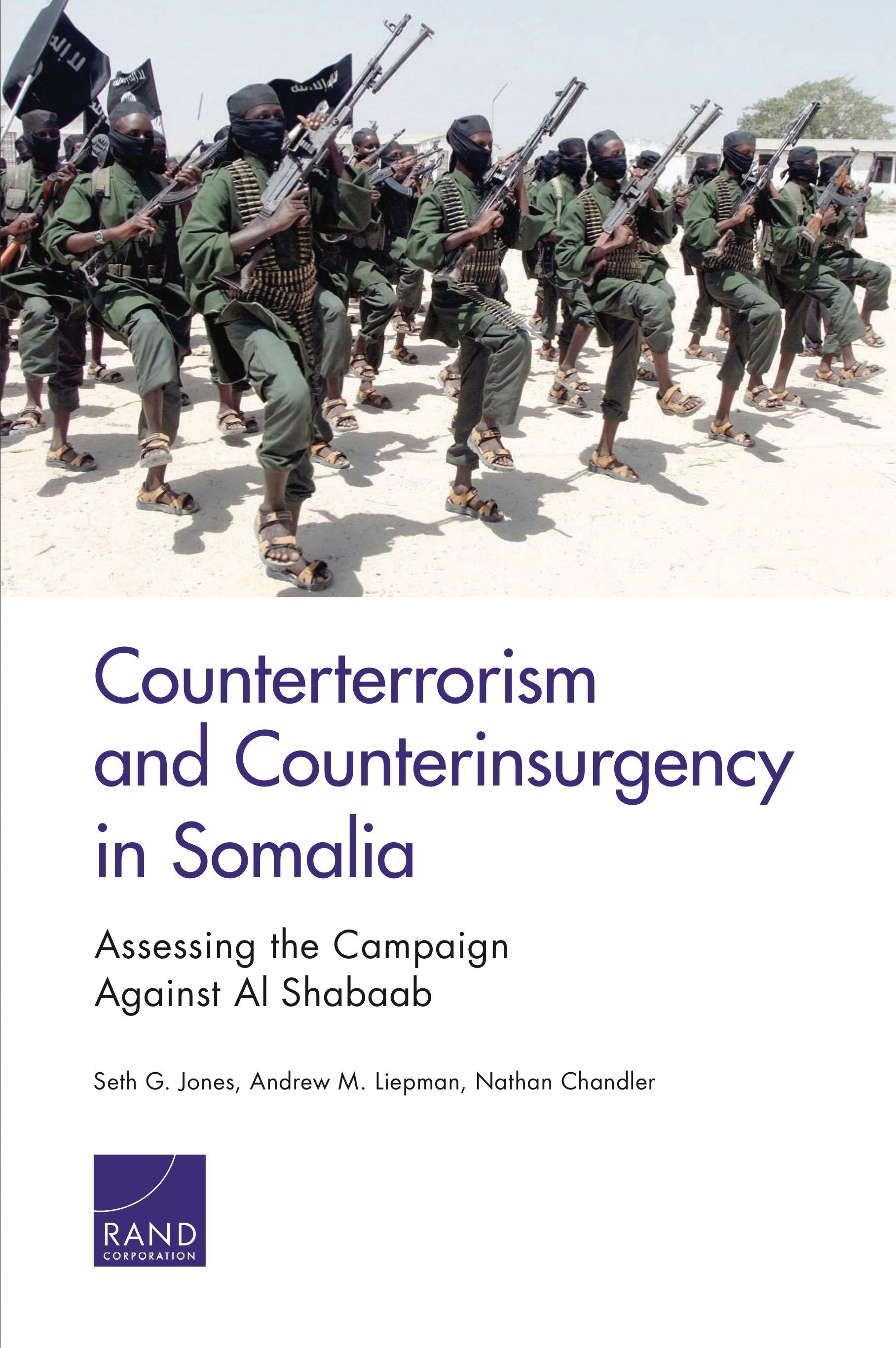
Based on open source material and testimony from recent defectors, the aim of this post is to provide an insight into the current state of al-Shabaab (aS).

As we enter Ramadan, a period that is traditionally accompanied by an upsurge in violence, and then the 2016 Elections period (due to conclude on 20AUG16) and which will, inevitably, also be the focus of aS operations, it is useful to assess the state of aS. However, this is only an assessment: it is based on the limited sources available and it should not, therefore, guaranteed to be completely accurate nor should strategic decisions be based upon it.

At the same time, this does not represent the views of any institution or any individual other than Our Man on the Horn.


Overview

Despite losing a considerable amount of territory, aS still retains control of about 20% of the South/Central Somalia including the Jubba River Valley, as illustrated by the two AMISOM-produced maps below.

Figure 1: aS Loss of Territory JAN-OCT2014

Slide1

January 2014                                           

Slide2

October 2014


In particular, aS remains capable of mounting attacks against the Federal Government of Somalia (FGS), the Somali security forces, the African Union Mission in Somalia (AMISOM), the international community and neighbouring countries. aS faces many challenges: but is by no means a spent force since, like many terrorist groups, it is flexible, scalable and survivable.


Organisation

In terms of numbers, aS is estimated to have at most 13-14,000 personnel, although many are merely supporters or involved in non-combat activities. But anything up to half are members of Jabahaat (military wing) or Amniyat (secret police/ intelligence).

In terms of demographics, the majority of foot soldiers are aged 15-25, have at best primary level education and are from rural backgrounds. Reasons for joining vary: financial, for adventure, grievance-based vengeance, nationalist impulses, religious ideology or simply that they were ordered to join by elders as part of clan commitments to provide fighters. Commanders, on the other hand, are generally better educated, more ideologically motivated and have strong links to other, more senior commanders.

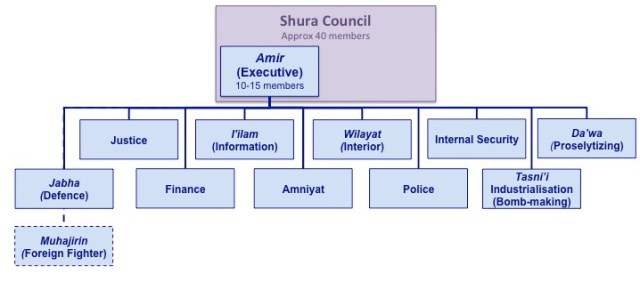
A representation of the overall governance structure of al-Shabaab, which is by no means exhaustive, is given below.

Figure 2: aS Organisation

14FEB16 aS Amir Org

  • Jabahaat (Defence) is in charge of defence and the conduct of military operations. It has both Regular, territory-focussed Divisions as well as Special Brigade units (these should not be confused with the ‘Named Brigades’ referred to in video products, which are drawn from across the organisation for specific operations).
  • Muhajirin is responsible for the administration of non-ethnic Somali foreigners who are dispersed across the different departments.
  • Justice is of interest in its role as a travelling impartial court: members become experts in clan dynamics as well as Shura law. This reflects key elements of al-Shabaab’s enduring appeal: seeming incorruptibility and cultural affinity.
  • L’ilal (Information) is the mouthpiece of aS, responsible for managing all of its media outlets such as well as special propaganda productions (in co-operation with aQ’s media house, al-Kutaib).
  • Amniyat is one of the most important as well as notorious offices of the organisation and is focussed on covert operations, both internally and externally.
  • The Finance office is the lifeblood of the organisation, in charge of income streams as well as the subsequent distribution of monies.
  • Wilayat (Interior) is responsible for all internal policies with regards to community engagement, internal security, and management of regional policies.
  • Tasni’i (Industrialisation or Bomb-Making) is the military design element of the organisation, which is responsible for efforts such as making explosive devices.
  • Da’wa, on the other hand, is often mistaken for Recruitment, whereas it is in fact a loose grouping of religious authorities who are also well versed in persuasive rhetoric. Da’wa does not have a guaranteed place on the Executive.

This structure is fluid, reflecting the changing needs of the organisation; elements are added and removed as required. In 2009, for instance, the Foreign Fighters office was created to appease a senior leader, Nabha. Its commander was added into the Executive in order to contain the potential threat from that volatile group.

Each element has its own individual structure that fits its task but all are designed to be robust, with at least two deputies under each minister/Emir. This is presumably designed to address the reality of the situation for the leadership of al-Shabaab: they regularly meet an untimely death. However, this also allows for the regular rotation of personnel without a loss of institutional knowledge.

Jabahaat (Defence) is particularly interesting. Using up roughly 70% of the outputs of Finance’s activities, Jabahaat apparently mimics the structure of the Ethiopian military (various entities were studied and the ENDF was agreed to be the most relevant to the formative al-Shabaab). The structure of Jabahaat is shown below.

Figure 3: Jabahaat Structure

Slide2

As well as five regional Jabhas (Divisons/Brigades) covering the areas that al-Shabaab currently or up until recently controlled (and where it often still operates – such as Mogadishu city), three additional Special Jabhas cover other territories of interest to al-Shabaab: Puntland in north eastern Somalia, Ethiopia and Kenya.

However, these ‘Special Jabhas’ should not be confused with the Special Forces Brigade used in the attacks on AMISOM positions in Southern Somalia. Commonly referred to as the ‘Abu Zubayr Brigade’ (in memory of the former leader of aS, Godane, killed in a US drone strike on 01SEP14). This regular unit leads large-scale attacks on isolated AMISOM & SNA positions in the hinterland of South/Central Somalia (such as the recent Leego, Janaale and El Adde attacks). It is viewed as being an ‘elite’ unit and is modelled, ironically, on Israeli Special Forces. (Occasionally the brigade uses the name Nabha Brigade as a provocation to the Kenyans – Nabha was a Kenyan-Somali, so this alias was eminently suitable for the attack on the Kenyan forces at El Adde.)

Being a member of the Abu Zubayr Brigade brings benefits beyond the mere kudos of being in an elite unit: those who participated in the recent attack on the AMISOM (KDF) position at El Adde apparently received a $400 bonus and 2 months leave; commanders were promoted.

Challenges for aS

aS currently faces many challenges. Many revenue streams have been lost or have dwindled. Illicit trade in charcoal, counterfeit goods and smuggling have all been interfered with by aS’s loss of control of the Somali littoral and the counter piracy maritime blockade means aS can no longer levy harbour fees on pirate gangs.

Since aS is no longer in control of ground it is no longer in control of people so it can no longer levy zakat or taxes. Donations from abroad via money transfer (hawalada) have effectively ended with the withdrawal of international banking support. As a result, aS has increased tax on the areas it does control with a commensurate loss of public support.

(However, despite numerous media stories to the contrary, it should be noted that there is no convincing evidence of ivory/endangered species smuggling.)

aS is also suffering the effects of attrition in two ways: members being killed or captured and defections (both leaders and foot-soldiers). The effects of attrition are all too clearly seen in the increasing recruitment (possibly press-ganging) of younger rural males, many of whom are, by western definition, child soldiers (although aS defines adulthood as being aged 15 years or older).

Strikes (the use of air power – drones and so on- and, increasingly, Special Forces raids), while controversial due to misuse/negligence in other theatres, are causing significant losses to the organisation. According to recent defectors, strikes are also having an effect on morale at all levels, a reflection of aS’s lack of air power, and absence of effective anti-aircraft systems and the inability to function at night. Strikes also cause significant disruption to aS communications and general pattern of life (avoiding concentrations, eschewing the use of cellphones and so on).

On the other hand, defections are also undermining aS’s ability to operate. Defections prompt resource intensive internal policing and purges, the promote distrust while at the same time posing little risk to the FGS and its allies. Significantly, in the last 18 months hundreds of footsoldiers have defected as well as 14 leaders (3 senior, 11 mid-level). Even more significant is the fact that those leaders come from a variety of clans, roles and locations. This is a trend, not a glitch.

The final challenge for aS is of an ideological and therefore potentially existential nature. aS continues to go through a period of internal friction over its future direction: is it still part of the global jihad, linked to al-Qa’ida? or is it a nationalist organisation fighting to rid the country of foreign invaders and their apostate lackies?

More recently, another schism has emerged: should aS remain loyal to al-Qa’ida or shift its support to IS/Da’esh, as one clan-focussed faction has done? aS is currently rife with barely suppressed divisions.


aS Strengths

However, aS is by no means finished as a violent insurgent force in Somalia and the region. aS continues to be able to operate with ease across the frontlines into FGS controlled areas and across borders into similarly volatile neighbouring countries such as Kenya and Yemen. It has also proven itself to be flexible, scalable and survivable, and this has allowed aS to continue to conduct not one but three lines of operation. ‘The 3-Pronged Approach’ that aS operates consists of urban terrorism, rural guerrilla warfare and transnational sectarianism.

aS specialises in the ‘propaganda of the deed’. Using urban terrorism as an example, since abandoning the city of Mogadishu in 2011, aS has mounted a campaign attacks against significant individuals (MPs, senior security forces personnel and so on), institutions, key locations (especially hotels) and high profile groups in society (journalists, women, the international community and so on).

For example, attacks in the city of Mogadishu in the first quarter of 2015 are shown below:

Figure 4: HPAs in Q1 2015

  • 22JAN: SYL hotel attack
  • 09FEB: MP assassinated in Hamar Weyne
  • 17FEB: Immigration personnel shot dead in vehicle near K4
  • 20FEB: Central Hotel attack
  • 21FEB: 3 VBIEDs reported roaming the streets
  • 28FEB: VBIED targeting security forces intercepted
  • 05MAR: Heightened threat to MIA for 72 hours
  • 11MAR: VBIED rear Makka-al-Makarama Road 
  • 27MAR: VBIED and suicide squad on Makka-al-Makarama Hotel


This meant that every 10-14 days aS mounted a High Profile Attack (HPA). While not all were successful and even some successful attacks yielded little in terms of casualties other than the attackers, the symbolism of being able to operate in the capital with impunity had the desired effect on public confidence. After a lull, it is worth noting that aS’s tempo of attacks is once again nearing early 2015 levels.


aS Communications

aS is also effective at communicating in ways other than attacks. aS retains a clear, consistent & simple ideology (outwardly at least) that remains attractive in isolated components, especially to those with limited perspectives (rural population, some Diaspora). aS has clear, simple lines of messaging that resonate: they are the most Somali, the most religious, the most capable of providing security and the most capable of providing services. aS messages at a high tempo in each of these areas concurrently.

aS also has a very effective mass communications operation which (its own organic production capability, al-Kataib) produces high quality one-off video products for distribution on the internet. Notable recent products include the foiled French SF Raid, the assault on Kodha Island, the attack on Westgate Mall in Nairobi, the cross-border incursion into Lamu County in Kenya and the over-running of the AMISOM bases at Leego, Janaale and El Adde. Products are produced in Somali, Arabic, Swahili and English.

Kodha Island is notable as it proves that aS actually does something that many institutions claim but actually never do: aS places the effect on public perception at the heart of their operational planning. This makes them considerably more adept than those they oppose. There was no reason to invade Kodha Island, except to produce a video product: no tactical gain (they left after 3 days), no resource to be purloined, no key individuals to be killed or captured. Just to make a video.


FOOTNOTE: The IS/Da’esh Faction

The final factor to be considered is the emergence of a dissident faction that has instead sworn allegiance to IS/Da’esh.

This group was initially small in number (28) and focussed entirely on a disaffected group of Darood in the Galgala Mountains of Puntland. Others have since joined them but it is assessed that the group still numbers less than 100. While aS reacted cautiously to the initial declaration, responding only with statements from senior figures, it was soon realised that the IS/Da’esh faction had gained some traction and a purge was launched.

Many of those who have attempted to join the IS/Da’esh faction have been victims of the purge, leaders being executed and foot soldiers being sent for ‘re-education’. Some foreign fighters (a term that aS uses to refer to members of the Somali Diaspora as well as the small number of non-ethnic Somalis in the organisation) have deserted and attempted to join IS/Da’esh in Puntland or elsewhere and have been captured by the government. aS’s recent ill-thought through amphibious assault on Puntland is thought to have been focussed on wiping out the IS/Da’esh faction, although it ended in an ignominious failure.

The IS/Da’esh issue is by no means yet resolved in aS’s favour. However, the media coverage, possibly stoked by the actions of some government institutions and elements of the international community, has been hysterical and has grossly over-inflated the strength and influence of the IS/Da’esh faction. This may, unfortunately, have the effect of allowing the IS/Da’esh faction to establish itself permanently in Somalia.


Seeds of Doubt: The El Adde Edit


Screen Shot 2016-04-10 at 06.32.03

It’s all about the video… An al-Shabaab cameraman films during the El Adde Attack

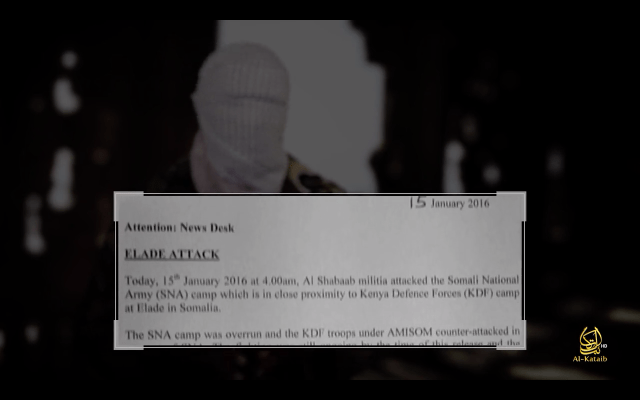
As al-Shabaab video products go, it’s not one of the better ones. While not as sprawling as the one-and-a-half hour Mpeketoni product, it is still a ponderous 48 minutes long (try blue-toothing that to your pal). Like the Mpeketoni video, a great deal of the build-up focuses on imagery of Muslims being abused by Kenyan security forces, followed by a reminder of the ‘body count’ of al-Shabaab’s various forays into Kenya (Westgate, Lamu County, Garissa, Mandera) carried out in apparent direct reprisal for and in defence of the oppressed Muslims of East Africa. (The logic of reminding the audience of atrocities, each almost exclusively against civilians, is questionable.)


Screen Shot 2016-04-10 at 06.25.50

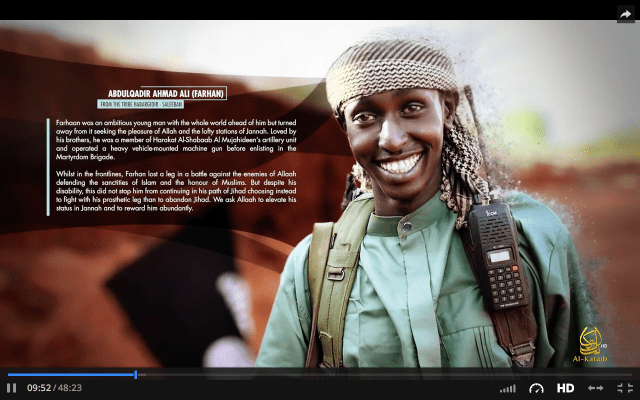
Monoped Farhan: not much use for anything else except suicide bombing

After the obligatory, lengthy suicide bomber ‘leaving speech’ (monoped Farhan of the Habargidir – not much use for anything else after he lost his leg, we must assume), the attack begins in the same old way, with a flash against the dawn skyline.


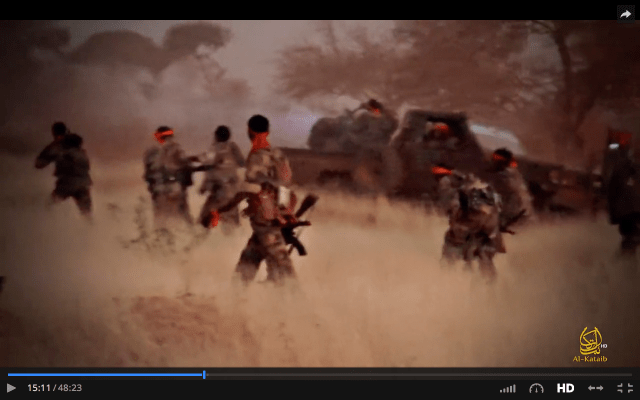
The attack, too, is very much akin to the previous video products produced on al-Shabaab’s behalf by al-Kutaib, al-Qa’ida’s media house. Technicals mounting Dushka heavy machine guns, twin 23mm anti-aircraft cannon go back and forwards. Plenty of ammunition is expended (sometimes aimed, mostly not), PK machine guns are fired from the hip and above the head, RPGs and heavy recoilless rifles engage targets (although two unfortunates standing behind one of the recoilless rifles appear to take the backblast in the face). Loose lines of troops advance at a gentle pace and begin to overrun the hotch-potch AMISOM position. Apparent leaders, rifles slung over their shoulders, kneel, speak into Tetra-style radios, give some direction. Most of the troops wear the proud badge of the Abu Zubayr Brigade, a bright orange flash, either as a head or arm-band.


Screen Shot 2016-04-10 at 06.31.51

A profusion of orange head- and arm-bands: not so much bravado as a simple control measure for troops unused to fighting as a unit

But there are jarring notes throughout, not just for the two clowns who forgot that some of the fiery fury that comes out the front of the recoilless rifle also comes out the back as well. Those bright orange bands must make nice aiming marks and, as much as they might be a piece of bravado, they might also be a unit marker, needed to a coordinate a loose rag-tag that has come together for the operation, probably never having worked as a formed unit before. (There are also some blue bands to be seen later in the video.)


More questioning of what we seem to be seeing. A colleague comments, ‘it’s some men firing at some bushes’: and she is right. For most of the video, we willingly suspend our disbelief and go along with al-Shabaab’s version of events. But most of the video is just that, men firing at some bushes, or a tarpaulin, or something, maybe a running man, in the distance.


Occasionally the fighters do shoot at a target – it takes a section strength group a few minutes, a few hundred rounds to hit a prone, probably already dead AMISOM soldier at a distance of about 30 metres. Despite the apparent profusion of anti-armour weapons (according to the editing at least), an AMISOM-tagged armoured car meanders through melee, does some ‘turning in the road using forward and reverse gears’ and goes away again.


Screen Shot 2016-04-10 at 06.23.46

Al-Shabaab uses the Kenyan government’s ill-judged messaging against it – again

The fighting putters out and, again, to a format, we view some burning vehicles, the shooting of some soldiers who are already dead, boxes and boxes of ammunition being carried away, imagery of al-Shabaab fighters wandering around a deserted town, a slideshow of dead bodies. The video product ends with the standard judo flipping of ill-judged Kenyan government and military messages set against apparently contradictory video evidence (the Kenyans really must ditch the ‘aspirational messaging’– al-Shabaab throws this back at them every time).


But numerous seeds of doubt are planted by this product. Yes, the Kenyans obviously lost a lot of troops: it was pointless and it continues to be pointless to claim otherwise. But virtually every one of the corpses is in helmet and body armour, holding a rifle. These men died fighting, and, small compensation to their families as that is, it is how soldiers are meant to die in battle. That deserves recognition.


Which leads to another point: where are the al-Shabaab casualties? Recently defected former fighters claim that al-Shabaab suffered something like 50% dead and wounded in the El Adde attack. Judging by their still-much-too-close spacing, their gentle, strolling pace as they advance and the atrocious marksmanship, that is feasible, especially when the Kenyan light armour started engaging. It is easy to forget that this is an edit, a propaganda product with a deliberate effect in mind, something to be taken with a very large pinch of salt and set against a backdrop of a disastrous, illogical amphibious assault in Puntland (probably 200+ killed out of 400) and a series of drone strikes (Raso Camp: nearly 200 killed) and special forces raids (various senior leaders killed). But, and in spite of over $20 million worth of communications projects focussed on Somalia, a plethora of radio stations, TV channels, websites and a purported ‘getting’ of Strategic Communications (after ten years of trying to ‘get’ Strat Comms in two other long CT/COIN campaigns), there is still no real challenge to al-Shabaab’s inconsistency-ridden messaging. No-one is answering the questions these video products pose.


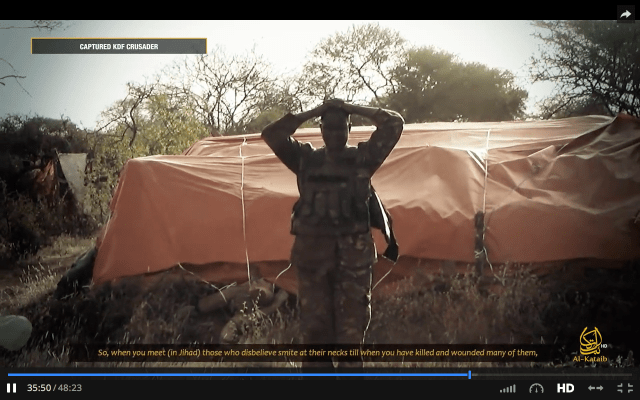
Hardest to forget, though, is the chilling sequence where a dazed Kenyan crewman appears out of the hatch of a stalled armoured vehicle. After a long section that captures his bewilderment all too well he is fired at, finally some of the rounds hit, he slumps, dies. That, along with an ominous message that many of the captured-and-paraded Kenyan troops subsequently ‘succumbed to their injuries while others still remain in captivity and their fate hangs by a thread’, has ramifications that we should not forget whilst caught up in an exciting video re-enactment of a battle. These are war crimes, outrages against humanity, and, one day, some of these murdering bastards should be held to account for that.


Screen Shot 2016-04-10 at 06.44.53

War crimes: a captured AMISOM soldier whose life, ominously, ‘hangs by a thread’


NOTE: as a matter of policy and out of respect to the dead we do not publish imagery of  the dead: we counter propaganda, not amplify it


Hmmm… – 3

How Terrorist Groups End

Putting aside the inevitable geek-ish questions about RAND’s methodology, how they defined a terrorist groups, CT campaigns that combined elements and so on, this pie chart is thought provoking.

If so few terrorist groups end as a result of military force (al-Qa’ida in Iraq, Tamil Tigers), why do governments continue to default to that approach? More terrorist groups actually achieve their goals than are defeated by military force, and the vast majority are driven out of business by policing and politicisation. But policing and politicisation are costly and take time, whereas we have all these soldiers standing around doing nothing…

‘Hmmm…’ is a series of short observations, too long for Twitter, too short for a proper posting.

The Shop-fronts of Mogadishu – 6

img_1667


Bar Kamal Diin

Via Moscow, Hamarweyne district, Mogadishu

Back in the day when literacy levels were low, Mogadishu shopkeepers would engage a local artist to depict their offerings on the exterior wall. Sadly these are disappearing and being replaced by blast walls and HESCO bastions or, worse still, the tatty plastic faux-glitz signs you see in every African and Middle Eastern city.


The Shop-fronts of Mogadishu – 5


Caaqil Shop

Police Academy, Mogadishu

Back in the day when literacy levels were low, Mogadishu shopkeepers would engage a local artist to depict their offerings on the exterior wall. Sadly these are disappearing and being replaced by blast walls and HESCO bastions or, worse still, the tatty plastic faux-glitz signs you see in every African and Middle Eastern city.

The Shop-fronts of Mogadishu – 4


Allaa Waldilee Bar Restaurant

Via Roma, Hamarweyne district, Mogadishu

Back in the day when literacy levels were low, Mogadishu shopkeepers would engage a local artist to depict their offerings on the exterior wall. Sadly these are disappearing and being replaced by blast walls and HESCO bastions or, worse still, the tatty plastic faux-glitz signs you see in every African and Middle Eastern city.