NATO COE-DAT Defence Against Terrorism Analysis – Quarterly

“Al-Qa’ida is in a battle, and more than half of this battle is taking place in the battlefield of the media. Al-Qa’ida is in a media battle for the hearts and minds of the ummah”

Ayman al-Zawahiri

The first issue of NATO Centre of Excellence Defence Against Terrorism (NATO COE DAT)’s new publication, Defence Against Terrorism Analysis – Quarterly is out. It includes excellent articles on the need for caution in the handling of far right extremists and the calculated abuse of children by terrorist groups, as well as Our Man on the Horn’s thoughts on communications around a terrorist incident, ‘Crisis Communications during Terrorist Incidents: The Somali Experience ‘.

NATO Strategic Direction & Krypteia – South: The Spread of al-Shabaab

NATO’s Strategic Direction – South in Naples, in conjunction with Krypteia, an East Africa-based research company, and Dr Harmonie Toros of the University of Kent, has published a fascinating new paper on al-Shabaab’s international agenda. https://thesouthernhub.org/publications/nsds-hub-publications/the-spread-of-al-shabaab-from-somalia-to-kenya-and-beyond

The paper can be downloaded here

Krypetia is a Somali woman owned business that was set up in 2014 and originally focused on translation between Somali, Swahili and English. Since then the company has expanded its activities significantly and now provides a range of services including media production, facilitation across East Africa and the Horn and specialist insight, with a particular focus on gender and CT & P/CVE. Client include the UN, the EU, the British Embassy Mogadishu, academia and the private sector, including private security providers. Krypteia recently provided two chapters (‘Women in al-Shabaab’ & ‘Negotiations with al-Shabaab’) in the UN’s War and Peace in Somalia collection.

Contact Krypetia on krypetiain@gmail.com

Seeds of Doubt: The El Adde Edit


Screen Shot 2016-04-10 at 06.32.03

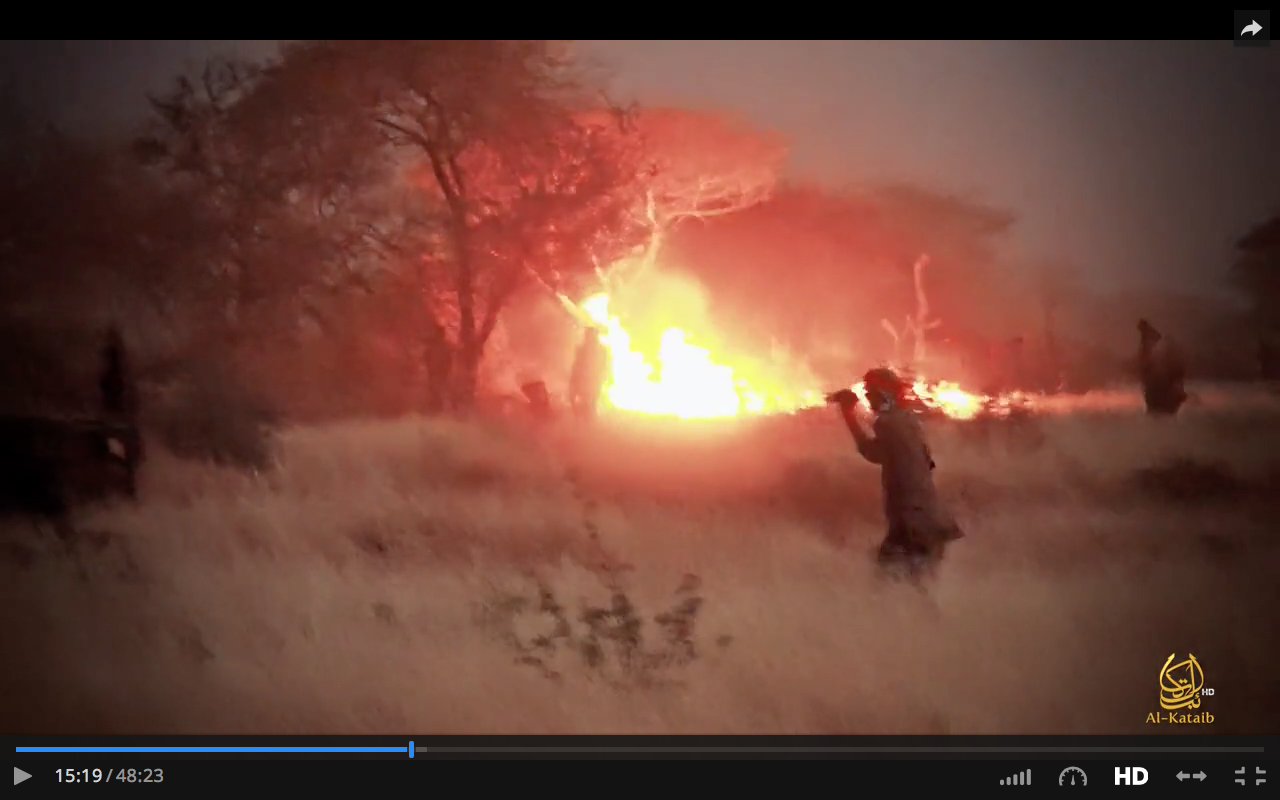
It’s all about the video… An al-Shabaab cameraman films during the El Adde Attack

As al-Shabaab video products go, it’s not one of the better ones. While not as sprawling as the one-and-a-half hour Mpeketoni product, it is still a ponderous 48 minutes long (try blue-toothing that to your pal). Like the Mpeketoni video, a great deal of the build-up focuses on imagery of Muslims being abused by Kenyan security forces, followed by a reminder of the ‘body count’ of al-Shabaab’s various forays into Kenya (Westgate, Lamu County, Garissa, Mandera) carried out in apparent direct reprisal for and in defence of the oppressed Muslims of East Africa. (The logic of reminding the audience of atrocities, each almost exclusively against civilians, is questionable.)


Screen Shot 2016-04-10 at 06.25.50

Monoped Farhan: not much use for anything else except suicide bombing

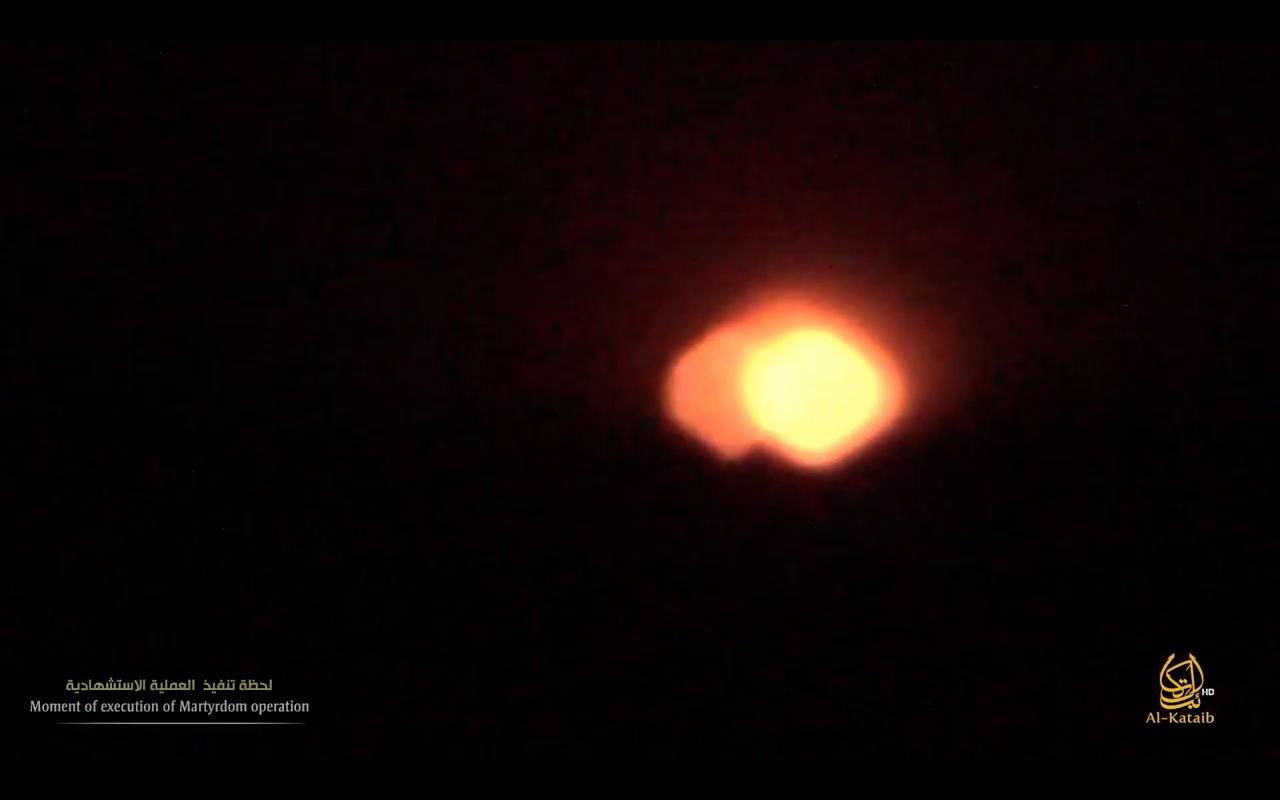
After the obligatory, lengthy suicide bomber ‘leaving speech’ (monoped Farhan of the Habargidir – not much use for anything else after he lost his leg, we must assume), the attack begins in the same old way, with a flash against the dawn skyline.


The attack, too, is very much akin to the previous video products produced on al-Shabaab’s behalf by al-Kutaib, al-Qa’ida’s media house. Technicals mounting Dushka heavy machine guns, twin 23mm anti-aircraft cannon go back and forwards. Plenty of ammunition is expended (sometimes aimed, mostly not), PK machine guns are fired from the hip and above the head, RPGs and heavy recoilless rifles engage targets (although two unfortunates standing behind one of the recoilless rifles appear to take the backblast in the face). Loose lines of troops advance at a gentle pace and begin to overrun the hotch-potch AMISOM position. Apparent leaders, rifles slung over their shoulders, kneel, speak into Tetra-style radios, give some direction. Most of the troops wear the proud badge of the Abu Zubayr Brigade, a bright orange flash, either as a head or arm-band.


Screen Shot 2016-04-10 at 06.31.51

A profusion of orange head- and arm-bands: not so much bravado as a simple control measure for troops unused to fighting as a unit

But there are jarring notes throughout, not just for the two clowns who forgot that some of the fiery fury that comes out the front of the recoilless rifle also comes out the back as well. Those bright orange bands must make nice aiming marks and, as much as they might be a piece of bravado, they might also be a unit marker, needed to a coordinate a loose rag-tag that has come together for the operation, probably never having worked as a formed unit before. (There are also some blue bands to be seen later in the video.)


More questioning of what we seem to be seeing. A colleague comments, ‘it’s some men firing at some bushes’: and she is right. For most of the video, we willingly suspend our disbelief and go along with al-Shabaab’s version of events. But most of the video is just that, men firing at some bushes, or a tarpaulin, or something, maybe a running man, in the distance.


Occasionally the fighters do shoot at a target – it takes a section strength group a few minutes, a few hundred rounds to hit a prone, probably already dead AMISOM soldier at a distance of about 30 metres. Despite the apparent profusion of anti-armour weapons (according to the editing at least), an AMISOM-tagged armoured car meanders through melee, does some ‘turning in the road using forward and reverse gears’ and goes away again.


Screen Shot 2016-04-10 at 06.23.46

Al-Shabaab uses the Kenyan government’s ill-judged messaging against it – again

The fighting putters out and, again, to a format, we view some burning vehicles, the shooting of some soldiers who are already dead, boxes and boxes of ammunition being carried away, imagery of al-Shabaab fighters wandering around a deserted town, a slideshow of dead bodies. The video product ends with the standard judo flipping of ill-judged Kenyan government and military messages set against apparently contradictory video evidence (the Kenyans really must ditch the ‘aspirational messaging’– al-Shabaab throws this back at them every time).


But numerous seeds of doubt are planted by this product. Yes, the Kenyans obviously lost a lot of troops: it was pointless and it continues to be pointless to claim otherwise. But virtually every one of the corpses is in helmet and body armour, holding a rifle. These men died fighting, and, small compensation to their families as that is, it is how soldiers are meant to die in battle. That deserves recognition.


Which leads to another point: where are the al-Shabaab casualties? Recently defected former fighters claim that al-Shabaab suffered something like 50% dead and wounded in the El Adde attack. Judging by their still-much-too-close spacing, their gentle, strolling pace as they advance and the atrocious marksmanship, that is feasible, especially when the Kenyan light armour started engaging. It is easy to forget that this is an edit, a propaganda product with a deliberate effect in mind, something to be taken with a very large pinch of salt and set against a backdrop of a disastrous, illogical amphibious assault in Puntland (probably 200+ killed out of 400) and a series of drone strikes (Raso Camp: nearly 200 killed) and special forces raids (various senior leaders killed). But, and in spite of over $20 million worth of communications projects focussed on Somalia, a plethora of radio stations, TV channels, websites and a purported ‘getting’ of Strategic Communications (after ten years of trying to ‘get’ Strat Comms in two other long CT/COIN campaigns), there is still no real challenge to al-Shabaab’s inconsistency-ridden messaging. No-one is answering the questions these video products pose.


Hardest to forget, though, is the chilling sequence where a dazed Kenyan crewman appears out of the hatch of a stalled armoured vehicle. After a long section that captures his bewilderment all too well he is fired at, finally some of the rounds hit, he slumps, dies. That, along with an ominous message that many of the captured-and-paraded Kenyan troops subsequently ‘succumbed to their injuries while others still remain in captivity and their fate hangs by a thread’, has ramifications that we should not forget whilst caught up in an exciting video re-enactment of a battle. These are war crimes, outrages against humanity, and, one day, some of these murdering bastards should be held to account for that.


Screen Shot 2016-04-10 at 06.44.53

War crimes: a captured AMISOM soldier whose life, ominously, ‘hangs by a thread’


NOTE: as a matter of policy and out of respect to the dead we do not publish imagery of  the dead: we counter propaganda, not amplify it


Al-Shabaab’s Eid Message: the Attack on Leego

Al-Shabaab’s latest video, produced by al-Qa’ida, reminds us of some old lessons and also teaches us some new ones.

The Attack Begins with the detonation of a Suicide Bomber

A suicide attacker initiates the attack on the AMISOM base in Leego


It’s sometimes hard to tell if al-Shabaab’s timing is as intentional as the media sometimes interpret it to be. Was the attack on Ugandan troops serving with AMISOM in Janaale on September 1st really in memoriam Godane, marking the first anniversary of his death in a drone strike? Was Monday’s attack near the perimeter gate of Villa Somalia really meant to coincide with the anniversary of Westgate? And was Thursday’s release of the obligatory video product that follows every major attack, this time of an attack on Burundian troops under the AMISOM flag in Leego, really al-Shabaab’s message for the people at the time of Eid al-Adha?

It doesn’t matter, of course, because whether it was or wasn’t, that is how social meeja and subsequently the media have interpreted it. And perception is reality, some say.

Once again the video product was produced by al-Kutaib, al-Qa’ida’s production house. Once again, al-Shabaab and Somalia provide the cast and the set for the ailing al-Qa’ida studio. The quality is consistently improving: there are at least three different cameramen (occasionally filming each other – how very Vice) and the editing is slick, with lots of split screens and the like. The subtitling again is in English and Arabic. The product as a whole is tighter, too, only 27 minutes this time, as opposed to the sprawl of some previous products, notably the 90 minute ‘Western Shopping Mall’ product (that fleetingly mentioned western shopping malls). It is undeniably exciting to watch the attack unfold, as graphic as the violence is and as ambivalent the thrill might be.

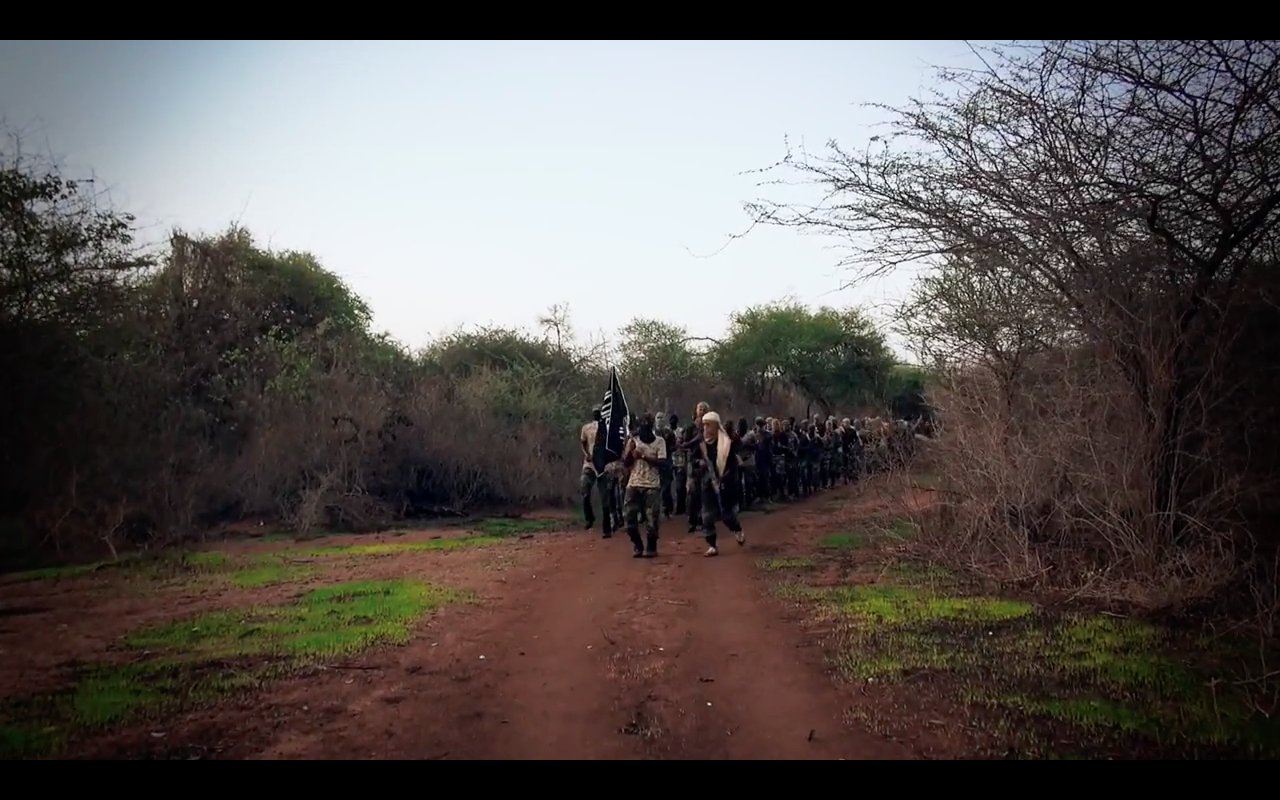
aS Parade Prior to Leego Attack

Al-Shabaab footsoldiers parade prior to the attack on the AMISOM base in Leego

The video itself begins and is subsequently punctuated by a series of inspirational comments from Osama Bin Laden, Godane and Zawahiri. Various scarfed footsoldiers prance around for a while but any comic value (they make the Italian Army on parade look intimidating) is lost when the camera pans out to reveals hundreds of fighters. A lengthy interview with a combat medic who has decided Allah has a greater role for him sings a song, looks wistfully into the distance.

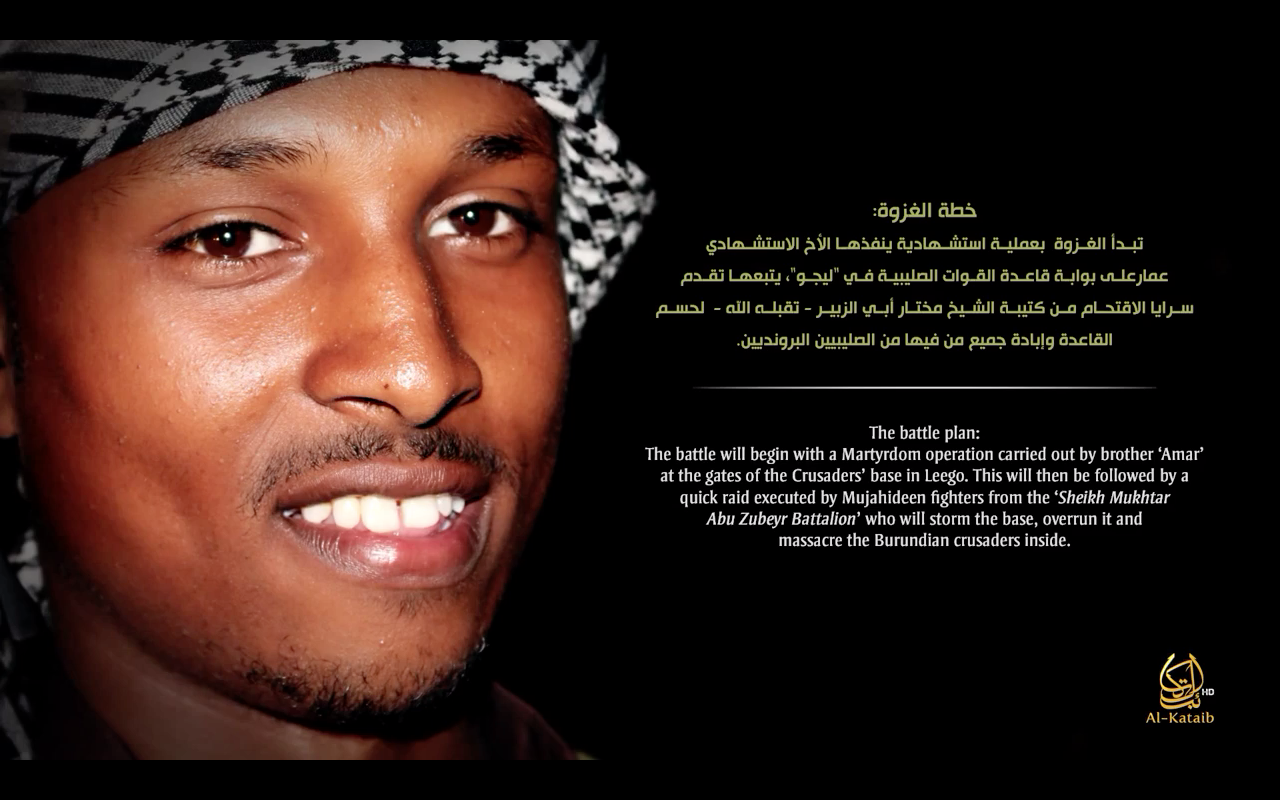
A Lengthy Interview with the Suicide Attacker Who Initiates the Attack

A suicide attacker, eulogised, initiated the assault on the AMISOM base

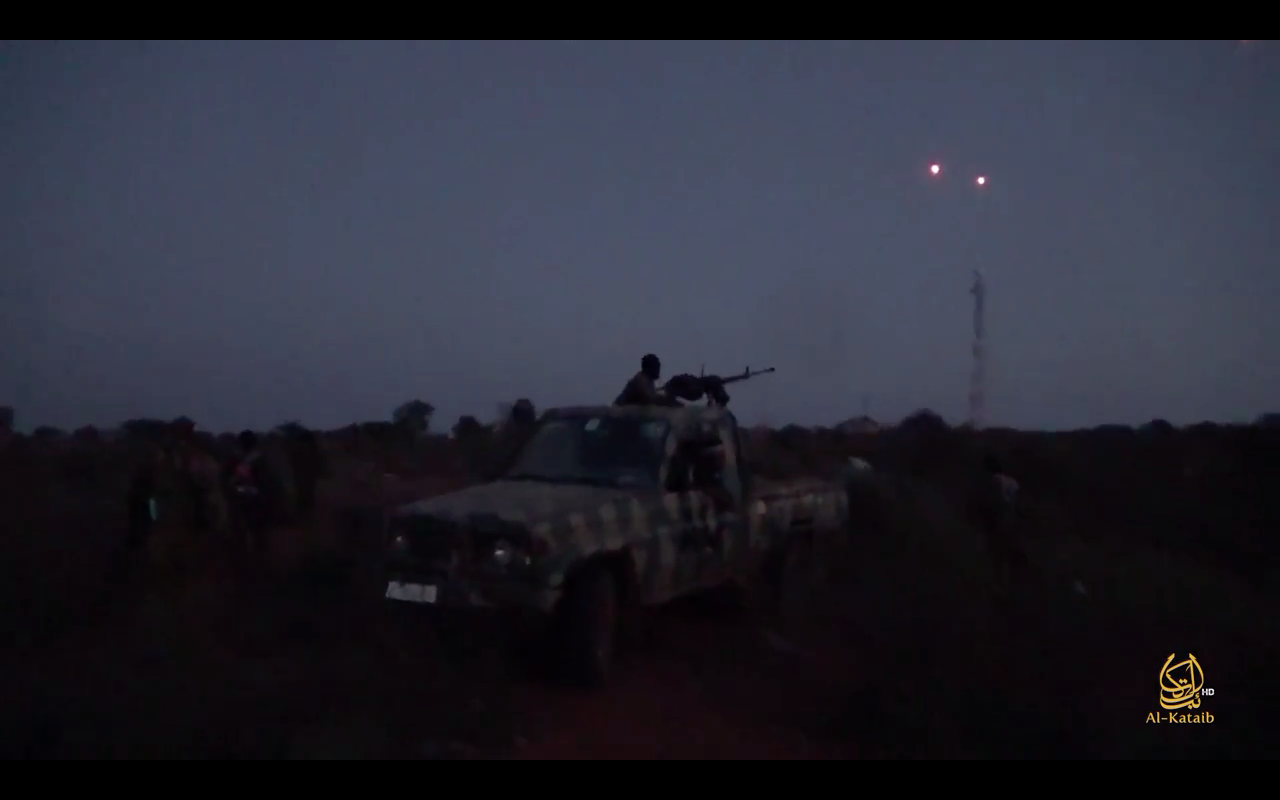
Darkness falls, broken first by the flash of the self detonation of the healer-turned-killer in the distance, then webs of tracer rounds from 7.62mm PK light machine guns and then the heavier 12.7mm Dushkas, mounted on the backs of 4×4 ‘technicals’. (A sharper eyed/more spotterish colleague spies even heavier ZSU 23mm anti-aircraft cannon mounted on technicals too. There are at least four different technicals involved, possibly more.)

Technical Mounted Heavy Weapons During the Assault

One of the many technicals mounting heavy weapons that were used in the Leego attack

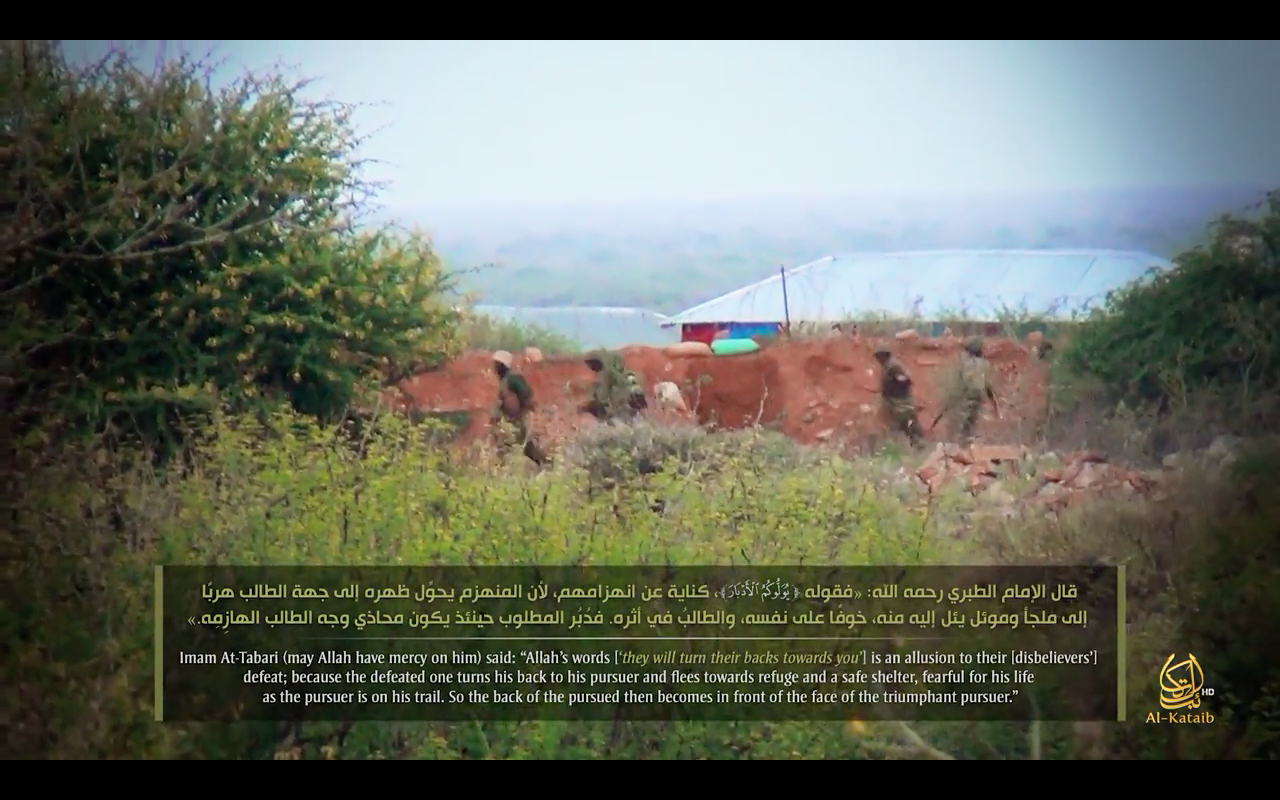
The assault itself takes place, strangely lacklustre after the build-up and the previous video products. Burundian troops are seen in the distance, in a mixture of states of dress, confused and meandering around entrenchments aimlessly.

Burundian Troops Move Along a Trench System

Burundian troops under fire meander along a trench

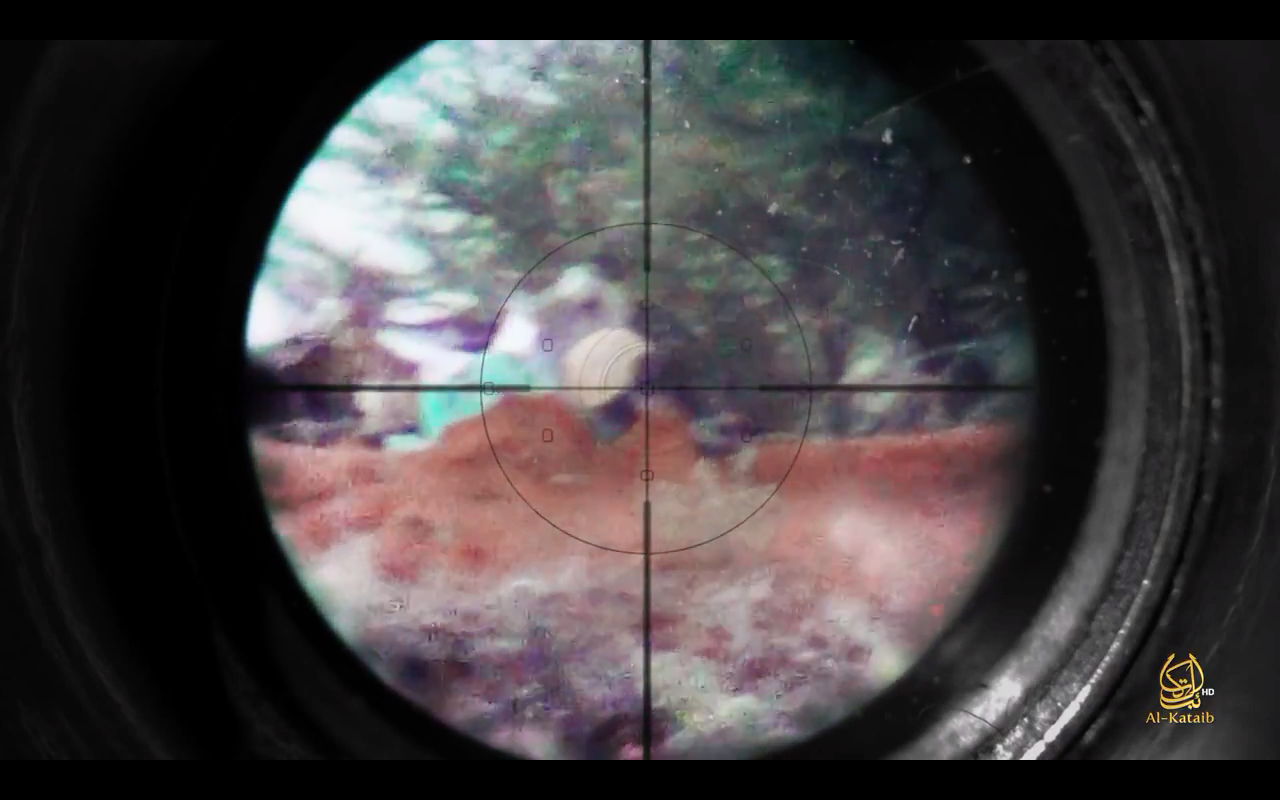
Sniper Shot

A sniper targets a Burundian soldier: probably a post-event overlay

The Burundian Church is Destroyed

The Burundian church is destroyed

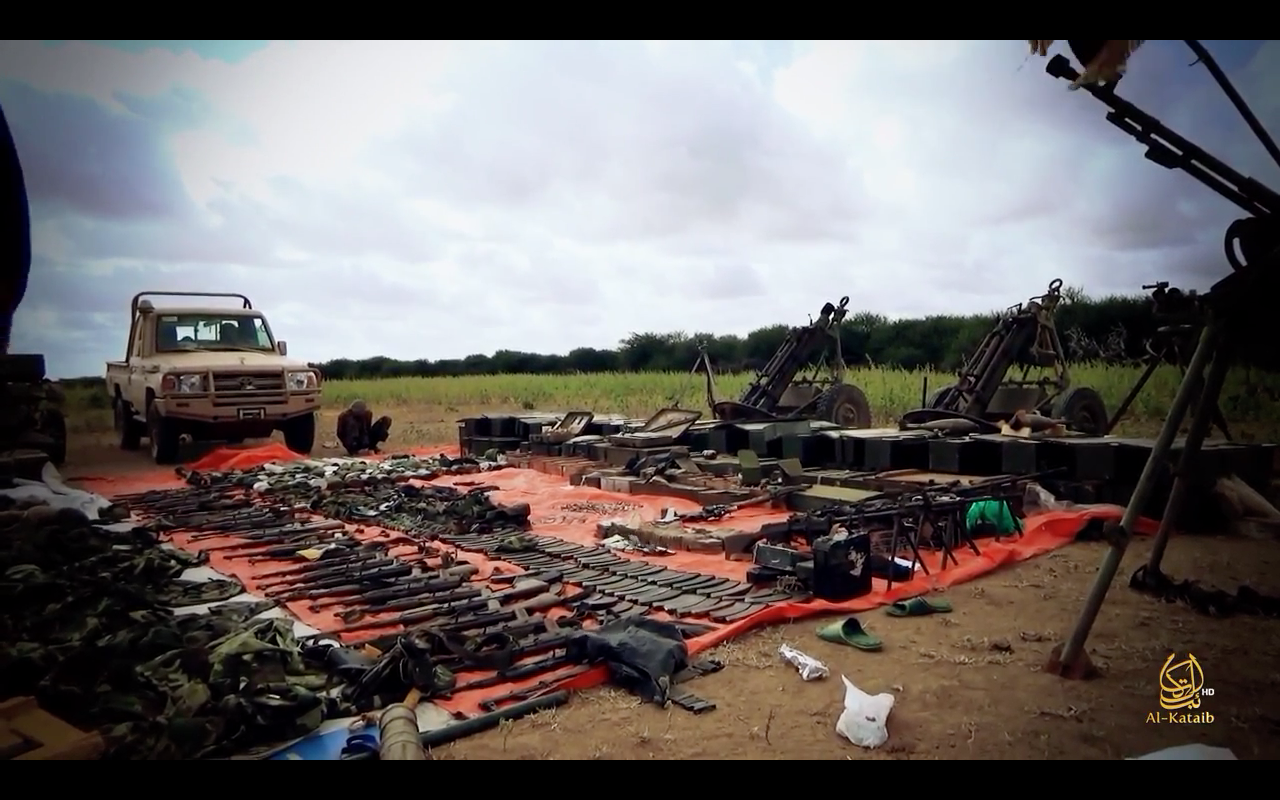
It is after the assault that the most striking images appear: a sniper scope view of a Burundian killed by a headshot, so derivative of many similar clips produced in Iraq; the destruction of the Burundian church tent, the cross stomped upon until it splinters; the seizure of quantities of ammunition, weapons (including heavy mortars), AMISOM uniforms and Burundian rank-slides; and finally, dead bodies. Many dead bodies.

Captured AMISOM Burundian Uniforms and Rank Slides

Captured AMISOM Equipment including Heavy Mortars and Ammunition

Significant quantities of arms, ammunition and uniforms were seized in the attack

Bodies are finished off with headshots; a series of single images of corpses build into a cascade, designed to justify the assertion that 80 Burundians were killed in the attack; bodies are strung together and dragged behind a technical.

Many of the messages from this video are not new. The video shows once again that al-Shabaab can concentrate large numbers of troops and weapons systems against isolated positions, seemingly at will. We knew this in December, when al-Shabaab attacked Interim Jubba Authority troops on Kodhay Island, but now the focus is on AMISOM. We also know that al-Shabaab will always produce a communications output from their operations and it is likely that they may even design their operations around the communications output. We also see that AMISOM, while they certainly outclass al-Shabaab in the offence, are weak in defence. The fact that al-Shabaab can mass vehicles and fighters and assault AMISOM positions with impunity shows that AMISOM has not yet adjusted to the physical terrain or to counter-insurgency: no aggressive foot-patrolling, no dominating ground, no exploitation of the technical advantage, no offensive spirit, obviously no support amongst the local population: all the tactics you would expect in rural counter-insurgency.

But there are is a new, albeit indirectly stated message: al-Shabaab’s allegiance remains with al-Qa’ida. Any doubt about that is confirmed by the fact that it is not just Bin Laden who is quoted in the video, but also Zawahiri. The media flurry around al-Shabaab’s supposed shifting of allegiance to the Islamic State can now be seen to be a red herring, although it allowed the Daily Mail to fill a few pages with pictures of Samantha Lewthwaite and stills from the latest ‘ISIS-style’ video release by al-Shabaab (who were producing such video products long before the Islamic State came into being).

One final, ominous thought. Al-Shabaab is releasing video products somewhere between 6 weeks and 3 months after each major attack. That means we can expect a video product based on the assault on the Ugandan-manned AMISOM base in Janaale earlier on September 1st (in memoriam Godane) in the coming weeks. That incident, rooted as it was in the loss of confidence of the local community after the massacring of members of a wedding party in nearby Marka (which in turn was in revenge for an IED attack on AMISOM forces) will once again cast doubts on AMISOM’s ability to operate in the rural environment. The subsequent confusion in reporting (12 dead, say Uganda; 25 dead say local sources; 50 dead say al-Shabaab), compounded by claims and counter claims of Ugandan hostages taken, prepares the ground for al-Shabaab’s next video. It is a sorry state of affairs when we have to rely on al-Shabaab to provide clarity on what is going on in the hinterland of southern and central Somalia.

POLICY: out of respect to fallen combatants and on the grounds of decency this site does not carry graphic imagery. If you wish to view the video for research, please send a request via the comments section below. 

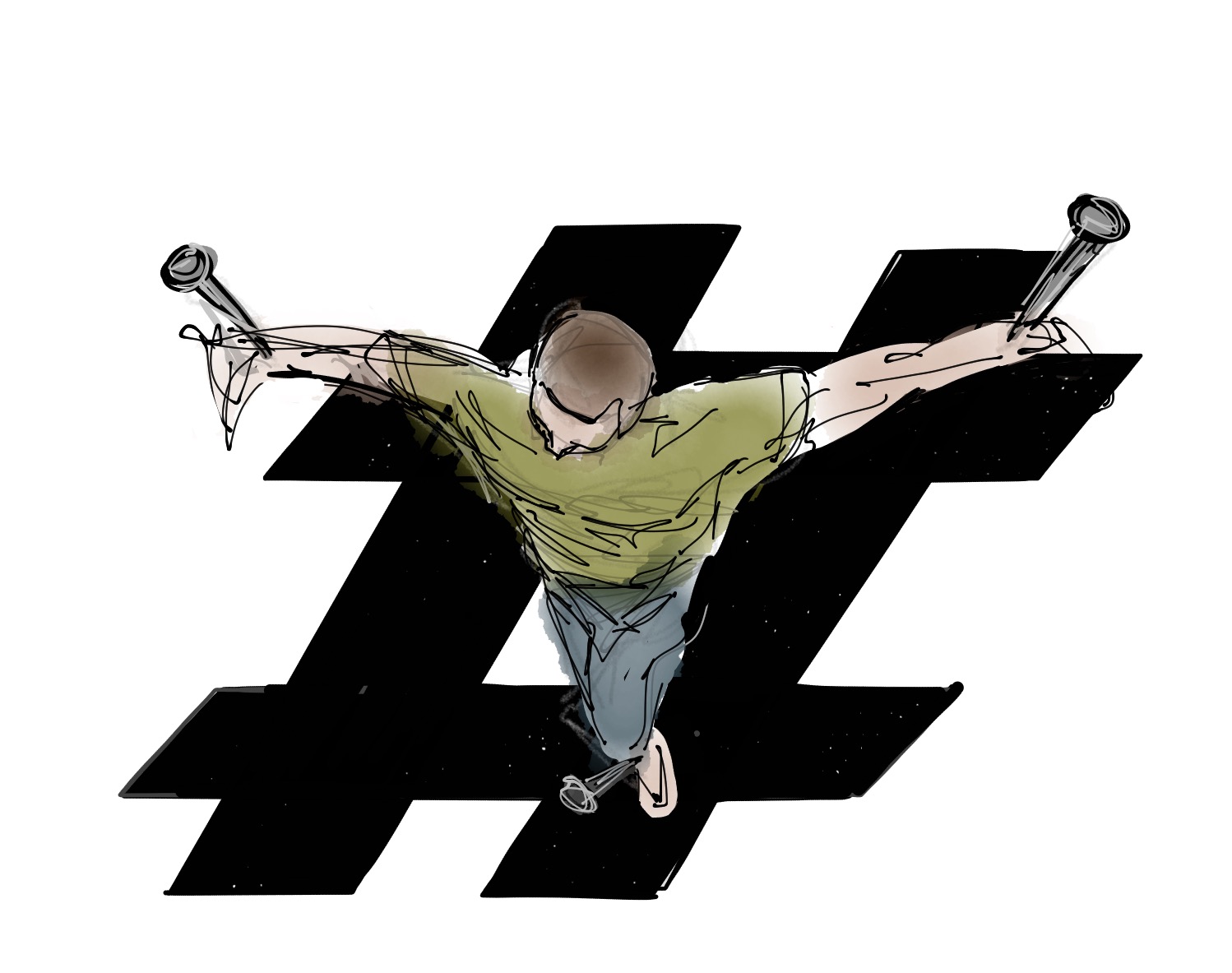
Death by Hashtag

Journalists now risk crucifixion on social media if they offend the sensibilities of Africans – maybe that’s a good thing.

DeathbyHashtag

As famous as the oral tradition of the Somalis is, that doesn’t mean that they don’t occasionally commit things to paper. As it transpires, and in spite of high (although mainly rural) levels of illiteracy, there is actually a voracious appetite for seeing the Somali language in print.

Riding on the back of the success of the long-running and internationally recognised Hargeisa International Book Festival, a local activist, Diini, decided Mogadishu needed its own book festival. So, on a rainy morning in late August (it rains in Mogadishu – not a lot of people know that) at the City Palace Hotel, books perched like birds on the hand and the poets and authors of the city strutted their stuff in front of an audience of hundreds. (On the two subsequent days of the festival, that became thousands: people waiting for the weekend, people waiting to see if it’s worth the risk.)

The President attends: as an academic, he is obviously a book lover. Ugaaso Abukar Boocow, made internationally famous by her jocular Instagram miniatures of life for a Diaspora returner (@ugaasada), is also there. (Another surprise: she’s quite small. And bossy. And very good looking.) The wifi, generously provided by the telecoms company, Hormuud, buckles under the weight of postings.

And then, amidst all exuberance and the superlatives, the #mogadishurising and #theafricathemedianevershowsyou: a bomb blast.

Not an actual bomb blast. The City Palace Hotel is right beside the headquarters of the National Intelligence and Security Agency (NISA), and couldn’t be safer. The BBC provide the bomb blast. Mary Harper, a known Somaliphile and author of ‘Getting Somalia Wrong’, publishes a positive piece about the festival. So far so good. But the image attached to the article is the stereotype of Mogadishu: a street desolated by an explosion.

A new hashtag appears, started by Mohamed Ahmed Cantoobo (@cantoobo), another activist, who runs Act for Somalia: #someonetellmaryharper.

#someonetellmaryharper #Somalia is moving forward regardless of how @mary_harper and BBC chooses to portray

Others agree:

#someonetellmaryharper enough is enough, Somalis are defining their own narrative, and stereotypes won’t define us

@MogadishuNews

And, after the successful conclusion of the Book Fair without incident, still further:

In Mogadishu, ricocheting bullets and bouncing bazookas is replaced by retractable and quill pens #someonetellmaryharper

@Mazario2012

Abdihakim Ainte spreads the word:

Hello Kenyans: this hashtag #someonetellmaryharper is equivalent to #someonetellcnn. Speaks of Somali narrative. Please use and promote.

@AbdihakimAinte

#someonetellmaryharper is a development of another hashtag, developed during another case of western-media-offends-African-sensibilities-and-gets-hashtagged-to-death, #someonetellcnn. In the run up to the Obama visit to Kenya. CNN ran a feature (from the US, not from its Nairobi bureau), noting that POTUS was headed to ‘a region that’s a hotbed of terror’ – provoking a ferocious response from Kenyans on Twitter (#KOT) using the hashtag #someonetellcnn and eventually forcing an apology from CNN in the face of cancelled advertising contracts.

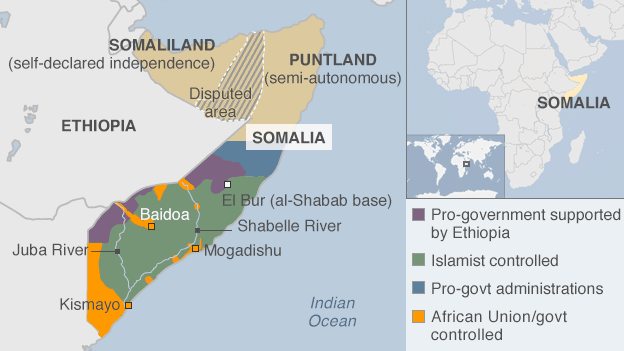
The BBC response was diversionary, muted. ‘An editor chose the photo,’ claims Mary Harper, ‘not me.’ That’s quite possible: the BBC has resisted pestering (mainly from this callsign, but also from BBC Africa staff) to update the map of the country it uses online, a map shows al-Shabaab controlling most of southern and central Somalia. It did: until 2012. Even last month the BBC used the out of date map for stories detailing the fall of towns like Baardheere and Dinsoor, deep in the heart of what used to be al-Shabaab territory. But the BBC doesn’t need to worry about big advertising contracts in the way CNN does. So the out-of-date map continues to appear. They are the BBC, after all.

_82428593_somalia_control_624_v2

The BBC map of Somalia – al-Shabaab controlled territory in green

Slide2

What al-Shabaab actually controls (in red)

After six days, use of the #someonetellmaryharper dwindles. (That’s double the normal duration for a ‘Trending’ hashtag. Somalis are persistent.)

But BBC or not, western journalists beware: young, articulate, connected Africans, brought up on Binyavanga Wainaina’s ‘How to Write About Africa’, are watching out for the next stereotype, the next attempt to use Africa to prove your adventure-journalist creds. And they have a hashtag with your name on it.

Off the Road and Into the Bush

The Campaign Against Al-Shabaab Moves Into Its Next Phase Prayer During Fighting

An al-Shabaab fighter bows and gives thanks while his colleagues rain down fire on paralysed AMISOM troops

With the fall in rapid succession last week of the towns of Baardheere and Dinsoor to the Somali National Army (SNA), supported by the African Union Mission in Somalia (AMISOM), it would appear that al-Shabaab is going through one of its periods of tactical withdrawal or, to be more accurate, re-posturing in the face of overwhelming military force. But nothing is ever quite as it seems in Somalia, particularly once you move out of the major cities, once you get off the road and into the bush (a metaphor that will recur in this piece). The SNA and AMISOM have claimed the seizure of Baardheere and Dinsoor – but what do the terms SNA and AMISOM mean in real terms in the hinterland of Bay and Gedo and Jubba? In the case of Baardheere it seems to have meant Interim Jubba Authority forces (formerly the Ras Kamboni militia, now fighting under the flag of the regional administration) supported by Kenyan Defence Forces airstrikes: in the case of Dinsoor it seems to have meant the Suffist militia, Ahla Sunna wa-Jama, supported by the Ethiopians. Across both operations, the US struck at targets with drones. The extent to which this was a coordinated operation between the SNA and AMISOM is debatable: it seems suspiciously like militias and the neighboring countries who capriciously support them, with the occasional Hellfire thrown in for good measure, latterly retrofitted with an operational name (‘Operation Jubba Corridor’) and a sense of an operational plan unfolding. The fact that both Ethiopia and Kenya have felt the sting of al-Shabaab in the past few months and feel obliged to retaliate adds credence to this reading of events. Or maybe it was planned back in Mogadishu. It just doesn’t feel like it. IMG_1240

SNA/AMISOM recently seized Baardheere & Dinsoor – or did they?


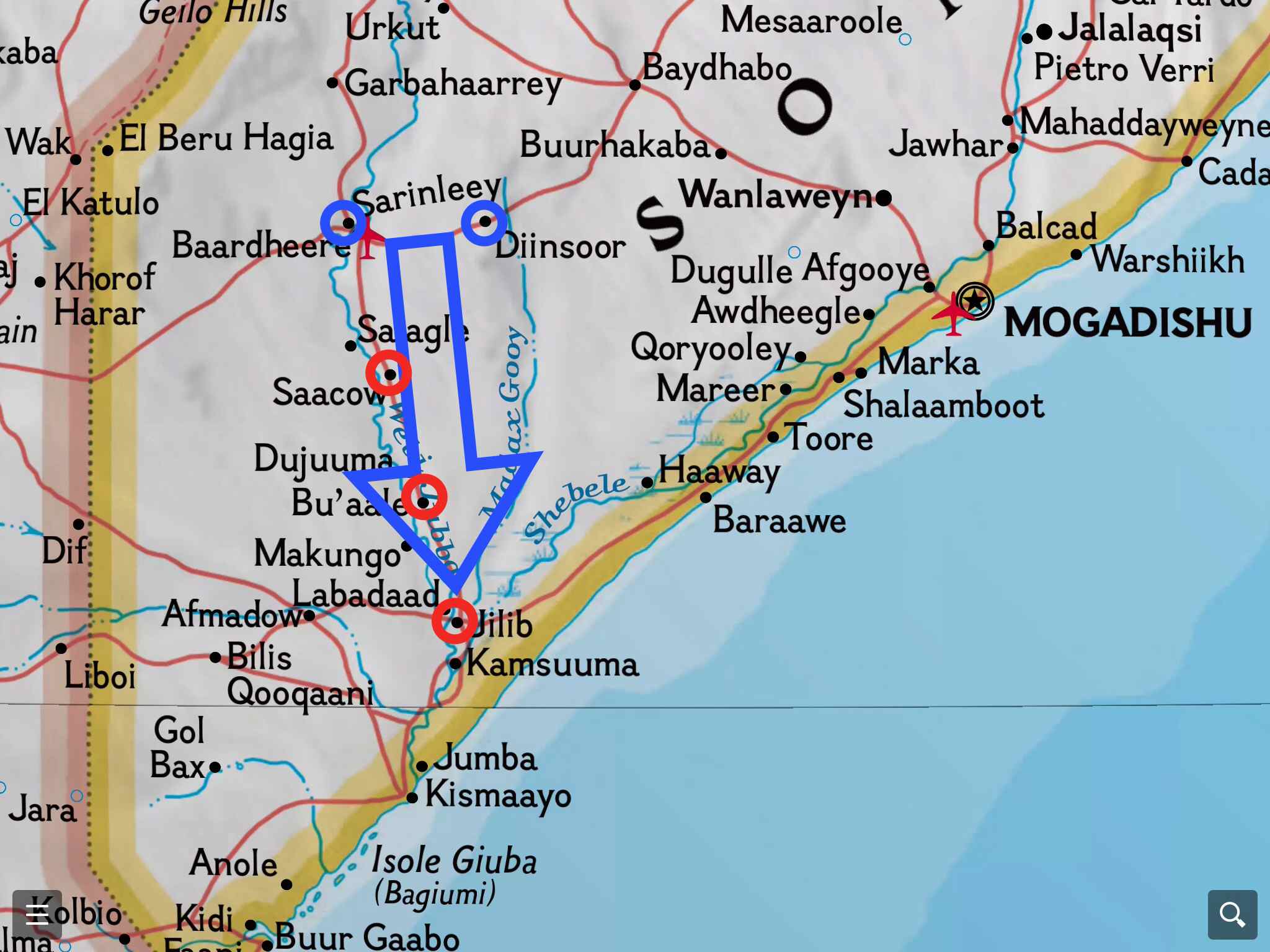
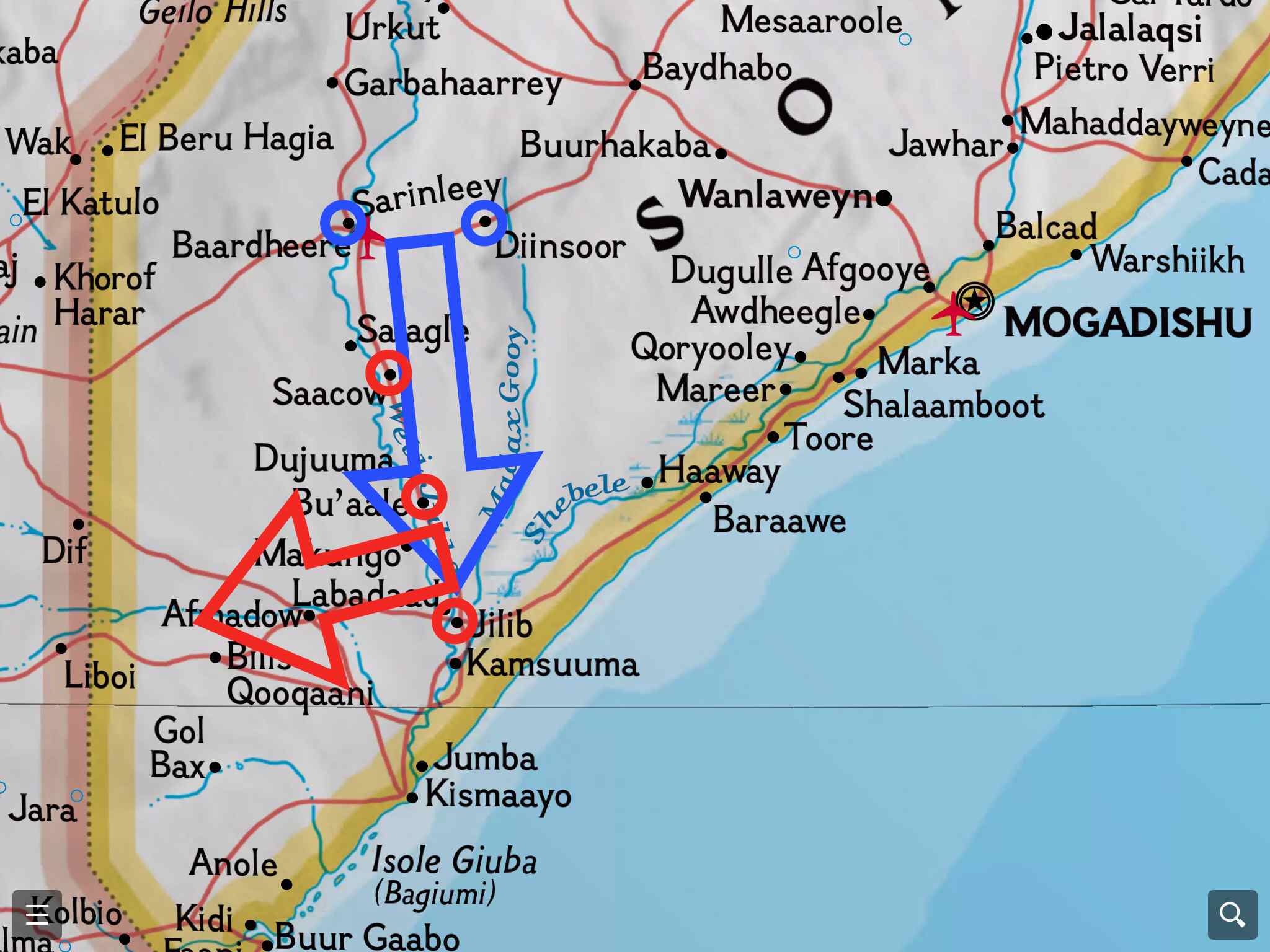
Al-Shabaab’s response was familiar. Its attempt to force a bloody urban denouement upon AMISOM during Ramadan 2011 badly backfired (although it was, nonetheless, bloody) and al-Shabaab’s response to its catastrophic losses was to simply melt away, mostly into the hinterland, some into plain clothes and anonymity of the urban environment. The successive AMISOM operations in 2014 to secure swathes of the countryside, first ‘Eagle’ and then ‘Indian Ocean’, were met with similar ‘tactical withdrawals’ and major objectives like the coastal town of Barawe were taken with little resistance. So too in Baardhere and Dinsoor, an orderly retreat. Radio Andalus, one of al-Shabaab’s propaganda nodes, was quietly shifted out of Baardhere and relocated, allegedly to Saaco, further down the Jubba River valley and towards the coast. But al-Shabaab is running out of places to withdraw to: Saaco, Bu’aale and Jilib along with a few villages along the way are all that remain in terms of conurbations. After Jilib there is only the sea. Admittedly, Jilib will be the proverbial ‘hard nut to crack’ – in the delta of the Jubba and Shabelle Rivers with the key crossing point being a bridge in the town of Kamsuuma, Jilib would be easy to defend. But it seems unlikely that al-Shabaab will choose to defend.


Advancing Thru Thicket

Al-Shabaab fighters move through the concealing scrub that covers much of the south of the country

Looking at the map and going on the images we have built up from the mass media, Somalia probably seems flat, featureless, a wasteland. But maps can be as deceptive as media reporting occasionally is, and the presence of the Jubba River challenges those preconceptions of Somalia being an arid expanse. Some parts of Somalia are indeed arid expanses. But major rivers, notably the Jubba and the Shabelle, crisscross southern Somalia and not so long ago the country was a bread-basket for the region. (Somalia, in fact, was once the world’s largest producer of bananas. You don’t achieve that status by being a wasteland.) But 25 years of chaos left the country disorganized and vulnerable to natural disaster. Just for good measure, al-Shabaab targeted the minority clans who specialized in farming. Agriculture collapsed. But much of southern Somalia, outside of the conurbations and roads, is scrub, highlighting the adage about the difference between the map and the territory.


If you have had the displeasure of viewing any of al-Shabaab’s most recent videos, which focus on ambushes of AMISOM convoys in a rural environment, you will be familiar with this scrub. Patchy, but generally above head height. Through this maze-like terrain the al-Shabaab fighters plan, scout, ambush. AMISOM Monging

AMISOM forces ‘monging’ while under fire

And it is from this angle, through the bushes, that we see the AMISOM troops through an al-Shabaab viewfinder: their armoured vehicles immobilized, they flounder, wander without aim as they are simultaneously filmed and fired at by al-Shabaab. At not point in either video do AMISOM troops appear to return fire, but that might be clever editing. The al-Shabaab fighters, on the other hand, seem confident and capable in this environment: orders are given around a model that would score highly at Brecon; every RPG round that is fired is celebrated with a fist-bump to camera; one fighter even pauses to bow down and offer a prayer in the midst of firing at the paralysed AMISOM troops. This terrain is definitely home to al-Shabaab, like the mountains are to a jaeger. It is into this terrain that al-Shabaab will most likely dissolve for the next phase of the campaign. Most likely they will shift southwest, towards the Boni Forest, a huge tract of land that was formerly a national park, an area that straddles the border with Kenya. At the same time others will dissolve into the cities. (The urban campaign is a different matter, requiring a different approach – and a different blog post.) IMG_1241

The most likely course of action for al-Shabaab: withdrawal into the bush


As al-Shabaab shifts away from the pretense of controlling territory, the SNA and AMISOM will be required to adopt different tactics, ones learnt and unlearnt in cycles by western forces, most recently in Iraq and Afghanistan. For the SNA, only now forming its first full integrated, multi-clan units and still woefully under-manned, under-equipped and under-trained, the shift to counter insurgency is probably still beyond their capabilities: conventional war still escapes them. But they do have the advantage of being part of the communities they will operate amongst, and that could be critical. AMISOM, on the other hand, stands a better chance of adapting to the nature of counter insurgency since many of its contributing nations have experience of bush wars (notably the Ugandans): but there is still an element of chance. AMISOM is lacking in critical equipment, particularly air power but also in communications, command and control and other key areas. But they do have the will to fight, as they have proven on countless occasions. If they can adapt to the changing nature of the fight they, along with the SNA, have a chance of placing a limit on the influence al-Shabaab can wield from the bush. A starting point would be permanently securing the areas they have recovered, not just during daylight hours (one of those cyclical lessons western forces re-learnt too late in Afghanistan).

‘BREAKING: Tonight #AlShabaab are back in at least 11 villages/towns in Bay & Gedo regions captured by #AMISOM troops this week,’

Reported Hamza Mohammed of al-Jazeera on July 23rd, just after the fall of Baardhere and Dinsoor. This fleeting experience of government influence is something that Afghans would recognise and it is makes a mockery of claims of a dividend in recovered areas. Along with security, the umbrella under which all other facets of governance can shelter, providing something tangibly different to what went before under al-Shabaab is desperately important but has, up to now, failed to materialise. But it is not too late: plans for ‘governance in a box’ exist, shipping containers ready to open up and reveal a clinic, a court, a school. They just need to be implemented , or ‘government’ will come to mean something that only exists in the daytime, surrounded by soldiers and not worth the risk of nocturnal retribution for ‘collaboration’. But it is not just the recovered towns, it is the arteries that run between those towns that will be critical to consolidating the recovered areas. The symbolism of securing those routes in the consciousness of the population in the hinterland cannot be understated. Many of the previously recovered towns exist under a state of siege. To achieve this, the SNA and AMISOM will have to adapt and the will also have to take the battle to al-Shabaab: they will have to get out of their vehicles, get off the road and head into the bush: literally and metaphorically. RPG Fist Bump

An al-Shabaab fighter gives a fist-bump in celebration after firing an RPG at an AMISOM vehicle

‘Are you Filming?’ ‘We’re Always Filming’

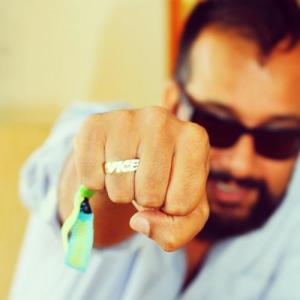
Vice Ring

A DAY OUT WITH VICE NEWS

‘These men are pornographers?’ says Abdi, one of the President’s comms team.

‘No, it’s just an attention grabbing name. It’s like Virgin. People used to think that was risqué.’

‘I don’t know… In fact, no, the President won’t see these people. As you say, it is risky.’ I know better than to try to clarify the homophone.

Moving down the feudal pyramid from the President in search of someone who is willing to speak to the Vice News crew, it gets no easier.

‘Vice did those great videos on the Islamic State.’

‘They make the videos of the beheadings, the burning of that pilot alive?’

‘No, I mean –‘ More rejection.


But we get there in the end – after completely re-organising the programme. The Minister for Planning, Abdi Aynte, is a former Jazeera journalist and also happens to have written his Masters thesis on the origins of al-Shabaab, so the pornographers/IS horror video producers get a decent insight into where the organisation came from, where it is now and where it might be going. And the government gets an input. Which is important.

Because Vice News, to those who are familiar with them, are neither pornographers or the PR team for Da’esh but are instead the spearhead of a kind of digital gonzo movement that is making news interesting again. (That’s ‘gonzo’ as in Hunter S Thompson, not as in porn.) Their material on the fighting in Ukraine was outstanding: their inside account of life under IS as alarming as it was riveting (their journalist had to take a break after filming, having got ‘a bit too close’.) And they will make this documentary whether the government cooperates or not.

A UN chum improvises a trip to a Defector Rehabilitation Camp in Baidoa, out in the hinterland of Somalia towards the Ethiopian border, and the trip coalesces into something. Vice News are happy.

It’s important that they are happy because the devil will find work for idle meeja to do if their ‘handlers’ don’t keep them occupied. They might end up filing a different story entirely. Like a story about all the boozing and shagging that goes on in the Mogadishu airport compound, where the UN and various embassies are hubbed, a story that came about because a journalist wasn’t kept occupied.

Or it might be a revenge story, as happened to an erstwhile colleague of mine back in Iraq in 2005 in the aftermath of two British SF soldiers being lifted by the shady Iraqi cops they were meant to be spying on, plunging the city into days of rioting. His opening gambit to the assembled ladies and gentlemen of Her Majesty’s Press: ‘You’ve been foisted upon us so don’t expect us to happy that you’re here.’ His reward: a feature on him and how shit he was.

*      *      *

In the back of the armour we chat about the interview with Aynte.

‘Some of his comments were obviously party line,’ says Suroosh Alvi, the host of the programme that is being filmed (‘TERROR’: a major documentary series on TERROR), who also happens to be one of the founders of Vice. ‘But very good, you can tell he was a journalist.’

Which is interesting, as the Vice crew (or should it be ‘VICE’, because that’s the way it’s cast on Suroosh’s trademark signet ring) pride themselves on not being trained journalists.

And that makes for a very different media visit from what I am used to (it’s been a while since I did any media handling) and also from what the private security company that is driving us around is used to as well. The mainstream media have become so bureaucratised, with all their disclaimers and risk assessments and their entourage of security advisors that their trips have become a breeze, since their masters are so risk averse and they have been brought up with the pernicious ‘embed’ as the norm.

But Vice are different. They have to be restrained from dashing to the Jazeera Palace Hotel when an al-Shabaab truck bomb peels the frontage off, killing 15. (But they get there later.) They are nearly in tears when we have to board the plane back to Mogadishu, a plane we cannot miss (unless we fancy a 5 day layover in Baidoa): the commander of the Ethiopian garrison offers to let them go up in an attack helicopter to see some action. But they got to meet some real, live al-Shabaab defectors, so the disappointment quickly passes.


The conversation in the armour drifts to the realities of the campaign against al-Shabaab. I nearly have an unguarded moment, but something from years ago, maybe the Defence Media Operations course, kicks in.

‘Are you filming?’ I ask the cameraman, Chris, who is squashed into the boot of the armour so Suroosh and I can sprawl on the back seat (and so Suroosh can do a piece to camera if need be).

‘We’re always filming,’ they reply, in unison.